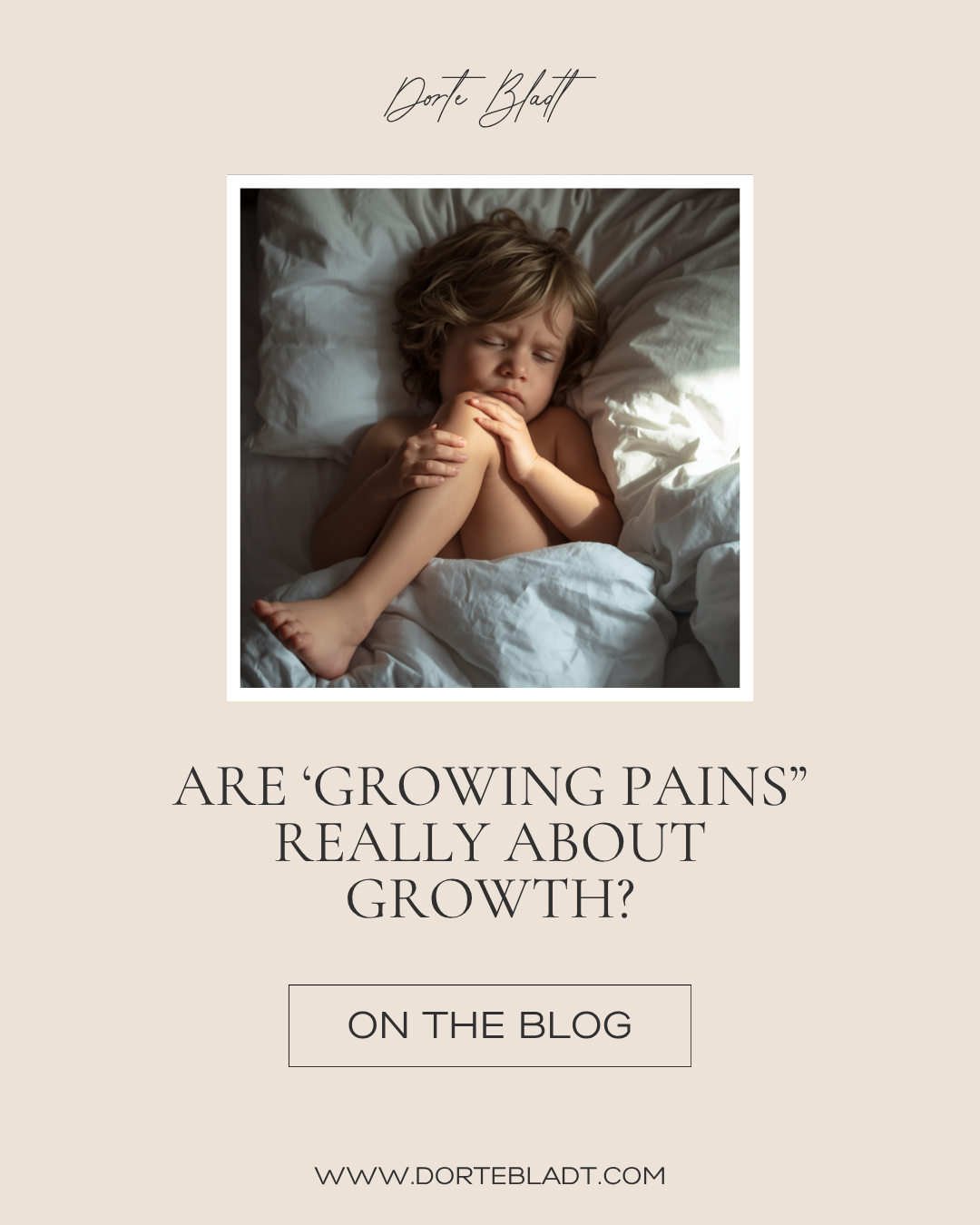
ARE ‘GROWING PAINS’ REALLY ABOUT GROWTH?
A mum of one of our young practice members came in to see me this week.
She’s in her thirties - fit, active, eats well and enjoys a full life with three little children. Her presenting complaint?
Growing pains.
She’s had them since childhood and knows the pattern well:
bilateral aching through the anterior thighs and shins, waking her suddenly at night, forcing her out of bed to stretch, massage and apply magnesium cream.
And it got me thinking…
How is it that nearly 200 years after this condition was first described, we still don’t really know what it is?
Not about growth after all?
Despite the name, current research does not support the idea that these pains are caused by growth itself. In fact, many authors now refer to the condition as:
“Benign nocturnal limb pains of childhood.”
A more accurate, descriptive term - yet still not an explanation.
Prevalence estimates range widely (2.6–49.6%), reflecting just how inconsistently this condition is defined and understood.
So what might be going on?
Rather than a single cause, growing pains appear to be multifactorial, involving a combination of:
Lower pain thresholds and altered pain processing
Reduced bone strength and load tolerance
Joint hypermobility and reduced stability
Vitamin D and iron deficiency
Sleep disturbance and possible overlap with restless legs syndrome
Genetic predisposition (up to 44% family history)
Psychosocial factors, including anxiety and emotional regulation
There are also associations with:
genu valgum and foot pronation
increased BMI
behavioural patterns such as irritability, fear of the dark, nightmares and heightened pain responses
Interestingly, perinatal factors such as shorter gestation, lower birth weight, lower APGAR scores and short breastfeeding duration have also been linked.
This is no longer a simple “muscle or bone problem.”
Where does chiropractic fit?
Growing pains are a common presentation in chiropractic practice - and many of us would agree, we often see positive outcomes.
A small RCT by de Beer (2015) compared spinal adjustments with leg massage in children with growing pains. The adjustment group showed faster and more significant improvement in symptoms.
While the evidence base is limited, proposed mechanisms include:
modulation of the pain gate
activation of descending inhibitory pathways
and broader effects on nervous system regulation
Importantly, this aligns with the shift away from a purely structural model.
Adjustments, and…
Here are some key areas to consider in practice:
1. Look at stability, not just mobility
Many of these children present with hypermobility.
assess joint stability and motor control
support postural development and movement efficiency
consider fatigue patterns throughout the day
2. Ask about sleep
Night pain is a hallmark.
explore sleep quality, restlessness and night waking
consider overlap with restless legs–type presentations
magnesium may help (nuts, seeds, leafy greens, as a supplement or topical)
3. Check nutritional factors
There are consistent associations with:
Vitamin D deficiency - especially in winter. (found in oily fish, egg yolks, liver and supplement with D3)
Iron deficiency (red meat, liver, chicken and supplement with Ferrous bisglycinate)
These are simple but often overlooked contributors.
4. Consider the nervous system
Children with growing pains often show:
increased sensitivity to pain
emotional reactivity
sensory processing differences
This is not “in their head” - it reflects how their system processes input. This is the work we do every day 😊.
5. Load and recovery matter
Many children are highly active.
consider cumulative load vs recovery
look at footwear, surfaces and daily demands
support balance between activity and rest
Final thought
That mum in her thirties reminded me of something important. For some children, this isn’t just a phase - it can be a pattern that persists if we don’t understand and address it properly.
As chiropractors, we are uniquely placed to look beyond the label.
Not just:
“What is hurting?”
But:
“What is this child’s system struggling to adapt to?”
And that’s where we can truly make a difference.
Dorte
REFERENCES:
1/ Pavone V, Vescio A, Lucenti L, et al.
Growing pains: What do we know about etiology? A systematic review.
World J Orthop. 2019;10(4):192–200.
2/ Günbey Ö, Gürgöze MK, Günbey FB. Vitamin D Levels in Growth-Paining Children. J Pediatr Acad. 2024; 5: 83-87
3/ Rosen AEV, et al.
Restless legs syndrome and growing pains in childhood: understanding the link.
Front Neurol. 2025;16:1603694.
4/ de Beer M.
The effect of lumbosacral manipulation on growing pains.
Health and Gesonheid 2015;20: 75-82
5/ Alcantara J, Davis J, Ohm J, Alcantara JD.
The chiropractic care of children with growing pains: a case series.
Complement Ther Clin Pract. 2011; Feb;17(1):28-32.
6/ O’Keeffe M, Kamper S, Montgomery L, et al. Defining Growing Pains: A Scoping Review. Pediatrics. 2022;150(2)