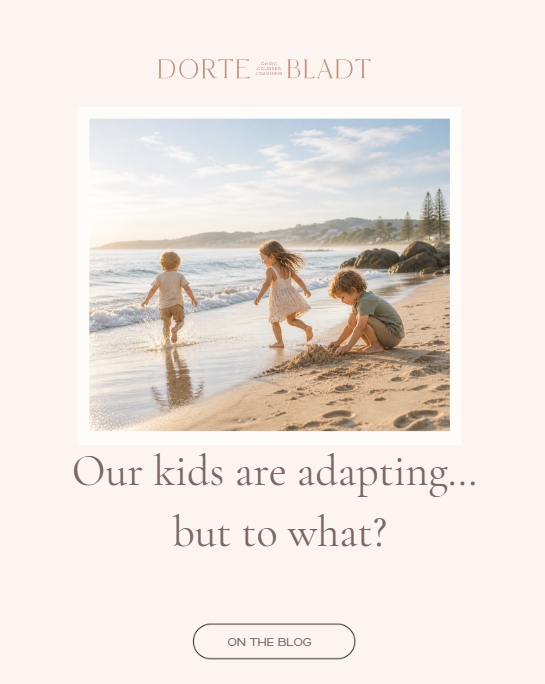
Our kids are adapting… but to what?
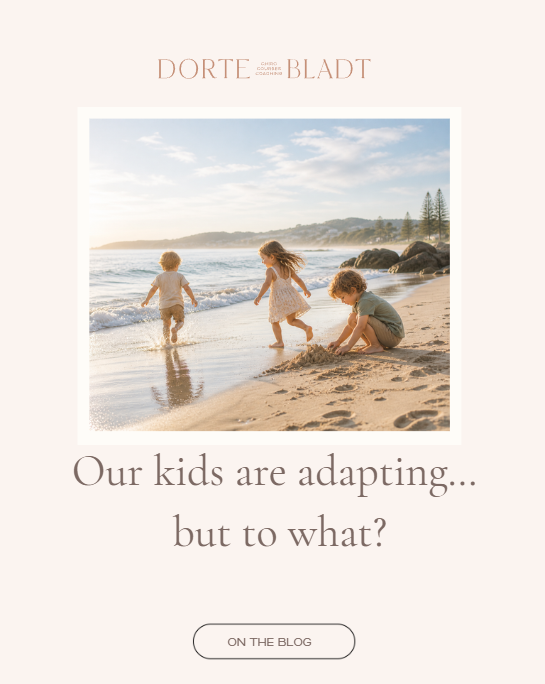
I was walking along the coastal path on one of those breathtaking Australian autumn days.
The sun was warm, the sky impossibly blue and the ocean rolled gently onto the white sand below. Birds circled overhead, dogs trotted happily on leads and children rode past on their bikes. Above the hill, colourful hang gliders lifted into the air, and, just to complete the scene, an aerobatics plane traced playful loops across the sky.
It was one of those moments where you can’t help but feel grateful to be outside, immersed in it all.
And then, walking towards me, came a parent pushing a double stroller. Two young children sat side by side - each with a device clamped directly in front of their face.
The contrast was striking.
Earlier that morning, a piece of information had caught my attention. One of those articles that pops up on your device when you least expect it, want it or need it. My interpretation of it on this glorious morning, was about the extraordinary innate ability of the human body to adapt to its environment. It’s something we talk about often in chiropractic: the intelligence of the body, its capacity to respond, to adapt, to survive and thrive.
The article discussed some changes that are being observed in the shape of the human eye. Traditionally, the eyeball reaches its full size by early adulthood.
However, this research suggested that increased time spent on near work such as screens, books and devices, may be contributing to elongation of the eyeball.
This elongation interferes with the eye’s ability to focus on distant objects, leading to myopia.
And while it’s easy to dismiss short sightedness as “just needing glasses,” the implications are far more significant. Myopia is now recognised as a leading contributor to vision impairment globally.
Increased axial length of the eye is associated with a higher risk of retinal detachment, glaucoma, cataracts and myopic maculopathy.
Children, of course, are particularly vulnerable to this elongation and myopia.
Their eyes are still developing, and the environmental inputs they receive matter.
Alongside near work, factors such as limited outdoor time, reduced light exposure, lower vitamin D levels and even dietary influences all play a role.
So how widespread is this becoming? The numbers are sobering.
In Australia, close to 30% of children are now myopic. In North America, rates have doubled over the past 50 years, reaching around 40% of the population. In parts of East Asia, the prevalence in senior high school children is reported to be as high as 80–97%.
Globally, it is predicted that by 2050, half the world’s population may be affected.
Curious to understand the scale of the environmental input, I looked a little closer at children’s screen use closer to home.
A recent study from Macquarie University reported that recreational screen use alone in Year 7–8 students averages nine hours per day. Even primary school children in Years 4–5 are spending over six and a half hours daily on screens.
That’s before we even consider school-related screen time.
We are, quite literally, giving the body’s adaptive capacity a run for its money.
So what does this mean for us as chiropractors?
In many ways, it brings us back to the fundamentals.
We are not here to treat myopia. But we are here to support the developing child - to help create an environment where the nervous system can adapt appropriately, not just cope.
And part of that conversation is lifestyle.
Encouraging families to prioritise time outdoors is not just a nostalgic ideal, it is increasingly supported by research. Exposure to natural light, distance viewing, green spaces, movement and unstructured play all contribute to healthier development across multiple systems including their eyes.
Sometimes the simplest message is the most powerful:
Get children outside. Let them move, explore, climb, run… or simply sit and be.
When near work is required—as it inevitably is—simple strategies can help. Many optometrists recommend the “20-20-20 rule”: every 20 minutes, look at something approximately 20 feet away for 20 seconds.
Small changes. Meaningful impact.
That moment on the beach stayed with me.
A world full of sensory richness, movement, light and life… and two young nervous systems receiving a very different set of inputs.
Our bodies will always adapt.
The question is, what are we asking them to adapt to?
And how can we, as chiropractors, help guide that conversation with the families we serve?
References:
https://www.theguardian.com/society/2021/nov/14/eyeballs-screens-vision-
nearsightedness-myopia
https://www.bbc.com/future/article/20220927-can-you-prevent-short-sightedness-in-
kids
Holden et al Ophthalmology Volume 123, Issue 5, May 2016, Pages 1036-1042
Wang et al BMC Ophthalmol 20, 2 (2020)
Marshall et al Curr Psychol 44, 11662–11672 (2025).